
Choose the right surface treatment.
A practical guide to choosing surface treatment for machined parts by corrosion, wear, appearance, conductivity, fit, and inspection needs.
A practical guide to choosing surface treatment for machined parts by corrosion, wear, appearance, conductivity, fit, and inspection needs.
Let's be honest: plenty of people can name anodizing, carburizing, tumbling, and passivation. Then a drawing lands on the desk and someone asks, "Which one should we use?" The room goes quiet.
That does not mean you are bad at materials. Surface treatment is often taught as a dry list of process names, while real parts ask much simpler questions: Will it rust? Will it wear? Does it need to look good? Must it conduct electricity? How much dimensional change can the fit tolerate?
So let us put the process names to one side for a moment and start with what the part actually needs.
What Surface Treatment Really Does
People sometimes describe surface treatment as "not touching the bones, only working on the skin." It is a useful picture, but do not take it too literally.
Some processes clean or texture the surface. Some convert its chemistry. Some add a coating with measurable thickness. Others, such as carburizing, nitriding, or induction hardening, change the properties of a shallow surface zone.
The practical goal is still the same: give the surface a property that the base material does not have on its own.
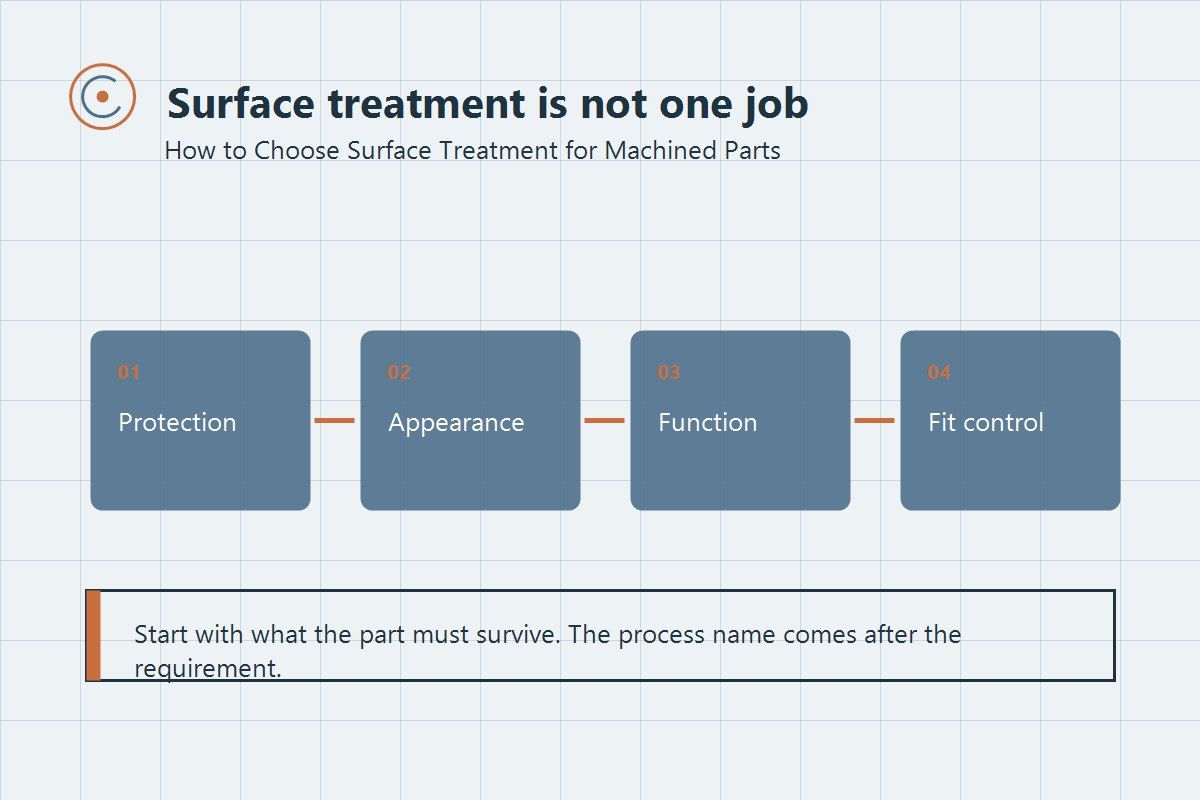
Most requirements fall into three groups:
- Protection: reduce corrosion, oxidation, chemical attack, or environmental damage.
- Appearance: control color, gloss, texture, and visual consistency.
- Function: improve wear resistance, friction, hardness, conductivity, insulation, cleanability, or another application-specific property.
Think of them as a raincoat, a new finish, or a job-specific tool. One process may do more than one job, but one process rarely does everything equally well.
The Process Families, Without the Textbook Fog
Mechanical Treatment
Mechanical processes use physical force. Blasting removes scale and creates a uniform texture. Tumbling and vibratory finishing soften edges and improve consistency on batches of small parts. Polishing, brushing, and satin finishing change smoothness and appearance.
Shot peening and roller burnishing go further: they are used to improve surface condition or fatigue-related performance when the part and process are suitable.
These processes are often the preparation, not the final answer. A beautifully blasted surface can still rust if the part needs corrosion protection afterward.
Chemical and Electrochemical Treatment
This group includes black oxide, phosphate conversion coatings, stainless-steel passivation, anodizing, electroplating, electropolishing, and electroless nickel.
They do not all work the same way.
- Passivation helps restore or improve the corrosion-resistant surface condition of stainless steel after contamination is removed. It is not a thick decorative coating.
- Anodizing grows an oxide layer on aluminum and certain other suitable metals. It can improve corrosion resistance, wear behavior, and appearance, and it may be dyed.
- Electroplating deposits another metal, such as zinc, nickel, or chromium, onto the part using electrical current.
- Electroless nickel deposits nickel through a chemical reaction without external plating current and is often considered when coverage, corrosion behavior, wear, or dimensional uniformity matter.
Paint, Powder, and Special Coatings
Liquid paint, powder coating, and e-coating cover the surface with an organic film. Powder coating is common on machine frames, guards, brackets, enclosures, and equipment panels because it offers durable coverage and a wide range of colors and textures.
Special coatings may be selected for low friction, non-stick behavior, high temperature, chemical resistance, or zinc-flake corrosion protection. The label alone is not enough; the specification still needs thickness, substrate preparation, cure condition, and acceptance criteria.
Surface Hardening and High-Performance Layers
Carburizing, nitriding, induction hardening, and laser hardening are not cosmetic finishes. They change hardness and wear behavior near the surface and may also affect distortion, grinding allowance, and final dimensions.
PVD and CVD coatings are widely used on cutting tools, dies, molds, and precision wear components. Thermal spray can build thicker functional layers for wear, corrosion, or repair applications. These are powerful processes, but they only work when the substrate, service temperature, geometry, and finishing sequence are right.
How to Choose Without Guessing
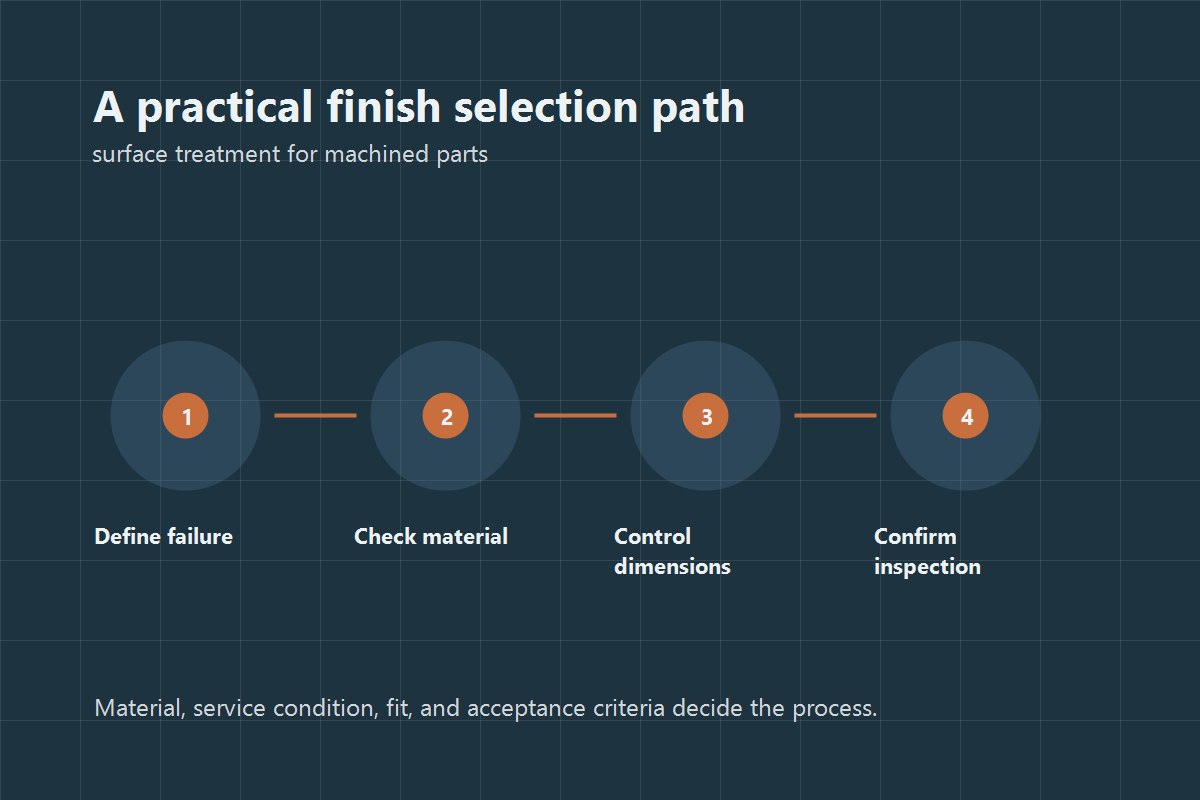
Here is the short version: do not start with "Which coating is best?" Start with "What is this part going to suffer?"
If the problem is corrosion
A carbon-steel bracket used indoors is a different case from an outdoor structural part or a component exposed to coolant and cleaning chemicals. Zinc plating, black oxide with oil, phosphate plus coating, e-coating, powder coating, or another system may all be possible, but they do not offer the same protection or dimensional effect.
For stainless steel, passivation may be appropriate after machining and cleaning. For aluminum, anodizing is often considered, but alloy, color, thickness, contact areas, and sealing still need to be defined.
If the problem is wear or friction
Look at contact pressure, sliding speed, lubrication, base hardness, operating temperature, and whether the part can distort during treatment. Nitriding, carburizing, hard plating, PVD/CVD, thermal spray, or simple polishing may solve very different wear problems.
If appearance matters
Do not write only "black" on the drawing. Define the process, color reference where needed, gloss or texture, acceptable color variation, visible surfaces, and whether machining marks may remain.
If fit matters
This is where many avoidable problems begin. Plating and coating add thickness. Anodizing grows partly into and partly above the original aluminum surface. Polishing, blasting, and chemical cleaning may remove material or soften edges.
Threads, bearing seats, sealing faces, electrical contacts, grounding points, and precision fits may need masking or post-treatment machining. The drawing should say which dimensions apply before treatment and which apply after treatment.
One Shop-Floor Truth: Pretreatment Decides More Than People Admit
The original source compares pretreatment to preparing a wall before decoration. That comparison is worth keeping.
If oil, oxide, rust, blasting media, or machining residue remains on the part, a good plating bath or expensive powder will not rescue the result. Cleaning, degreasing, activation, conversion coating, rinsing, and handling are not the boring steps before the "real" process. They are part of the real process.
The same applies after coating. Film thickness, adhesion, color, gloss, hardness, corrosion testing, masking condition, and visible defects should be checked against the drawing or approved specification. For electroplated high-strength steel, hydrogen-embrittlement controls must follow the applicable material and process requirements rather than one universal rule.
What to Put in the RFQ
For a machined part with surface treatment, send more than a process name:
- drawing revision and base material
- heat treatment condition before finishing
- required surface-treatment process and applicable standard
- coating or layer thickness, if controlled
- critical dimensions and whether they apply before or after treatment
- masking areas, threads, sealing faces, contacts, and no-coat zones
- color, gloss, texture, and cosmetic acceptance surfaces
- corrosion, hardness, adhesion, conductivity, or wear checks when required
- quantity, batch size, packaging, and part-protection expectations
Cost comes after these questions. Geometry, quantity, coating thickness, masking, racking, color control, testing, environmental requirements, and rework risk can change the answer. There is no honest universal ranking from "cheapest" to "most expensive."
Where Molitech Fits
Molitech manufactures accepted precision-machined parts and coordinates related finishing when it is required by the released drawing. We clarify the finish specification, dimensional allowance, masking, appearance criteria and agreed inspection evidence before quotation.
Molitech is the contracting supplier for accepted orders, but it is not the buyer's final surface-engineering authority. The buyer or qualified engineering team approves material and finish selection, performance validation and production release unless a signed contract assigns a specific design scope.
FAQ
Is anodizing the best choice for every aluminum part?
No. Alloy, wear, corrosion, color, electrical contact, precision fit, welding, and later assembly all affect the decision.
Does surface treatment change part dimensions?
It can. Plating and coatings add thickness, anodizing changes the surface layer, and polishing or blasting may remove material or alter edges. Critical fits need explicit allowance and masking instructions.
Why can two suppliers using the same process produce different results?
Pretreatment, bath or powder control, racking, current distribution, cure condition, handling, inspection, and the base material condition can all change the result.
Application note
Project-specific process selection should follow the drawing, material standard, application requirements, and qualified engineering approval.
For a machining RFQ, review Molitech Services and Product Scope, then send the drawing, material, application, finish requirements, and critical dimensions through Contact.
Discuss your drawing
Email PDF drawings showing dimensions, tolerances and the released revision to liwen@molitech-eng.com. A STEP model can be supplied later if needed.
Prepare a quotation enquiry